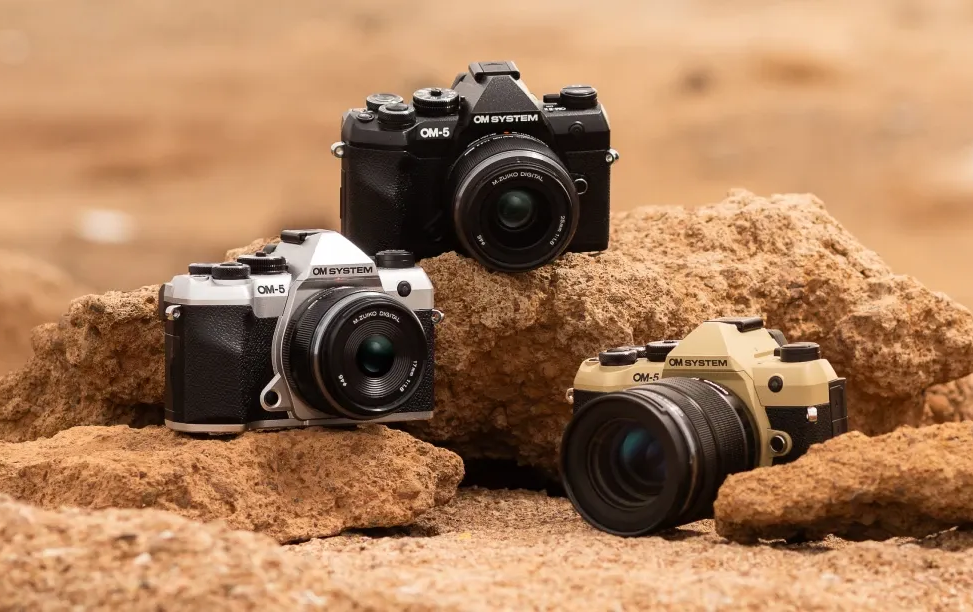
Hello, global explorers! Welcome back to Places4Photos.com, where we’re passionate about capturing the world’s landscapes and streets in 2025. Today, we’re thrilled to present the OM-5 II review 2025, a refreshed Micro Four Thirds mirrorless camera launched on June 17 by OM System. This compact powerhouse blends rugged durability with creative features, making it a contender for adventurers everywhere. Whether you’re trekking the Himalayas or wandering Tokyo’s alleys, let’s see if this OM-5 II review 2025 proves it’s your perfect companion. Grab your coffee, join us, and share your shots on P4P!
A Rugged Design for Global Journeys
The OM-5 II review 2025 introduces a 418g (14.7 oz) Micro Four Thirds body, available in black, silver, or a new Sand Beige limited edition, priced at $1,199.99 (body) or $1,599.99 (with 12-45mm f/4 Pro lens). Its slightly bulked-up grip enhances handling, while IP53 weather sealing—certified for dust and spraying water resistance—makes it a reliable choice for rain-soaked hikes or dusty trails worldwide. The USB-C port replaces the OM-5’s micro USB, and a new CP (Computational Photography) button simplifies mode access. At 125.3 x 85.2 x 49.7mm, it’s travel-friendly, though the plastic build feels less premium. Explore its design at https://www.dpreview.com/news/8051146633/om-system-om-5-ii-announced-subtle-refresh-with-new-color-option.
Performance Powered by Live MOS
The OM-5 II review 2025 features a 20.4MP Live MOS sensor paired with the TruePic IX processor, matching the OM-5 and E-M5 Mark III. This BSI (Backside Illuminated) Live MOS design enhances light capture, delivering solid resolution for global landscapes or street scenes. With 7.5EV IBIS (up from 6.5EV) and sync-IS lenses reaching 7.5EV, it stabilizes handheld shots anywhere. Burst rates hit 10fps (mechanical, continuous AF) or 30fps (electronic, fixed AF), powered by a 121-point phase- and contrast-detect AF system. The BLS-50 battery offers ~310 shots—decent for a day’s shoot. Dig into the tech at https://www.cameralabs.com/om-system-om-5-ii-review/.
Understanding the Live MOS Sensor Advantage
The OM-5 II review 2025 showcases its Live MOS sensor, a technology rooted in Olympus and Panasonic’s Four Thirds legacy since 2006. This BSI CMOS variant maximizes light entry, offering CCD-like quality with low noise and rich dynamic range—perfect for dim forest trails or city twilight. Its low power use enables live preview and long battery life, while fast readout supports 30fps bursts. Though it may not rival stacked sensors in speed or full-frame in low-light depth, its balance suits the OM-5 II’s compact design. Learn more about sensor tech online.
Comparing Sensor Types: Live MOS, Full-Frame, and Stacked
Curious how the OM-5 II’s Live MOS stacks up? The 20.4MP Micro Four Thirds sensor (17.3 x 13mm) is smaller than full-frame (36 x 24mm), which captures more light for superior low-light and depth of field—think Nikon Z9. Stacked sensors, like the Sony A1, layer circuitry for ultra-fast readout (120fps), reducing rolling shutter, while Nokia’s 9 PureView used multiple small sensors (1/1.2-inch) for computational HDR. Live MOS excels in portability and noise control, but its size limits resolution and speed compared to larger or stacked options. It’s a trade-off for the OM-5 II’s adventurous spirit.
Video and Display for Creative Flexibility
The OM-5 II review 2025 offers Cine 4K/24p and 4K/30p video (1.23x crop), with a 3.5mm mic jack but no 10-bit or 4K/60p—limiting pro video use. The 3-inch, 1.04M dot vari-angle LCD flips out for vlogging or low angles, paired with a 2.36M dot EVF. Computational modes like Handheld High Res Shot (50MP) and Live ND (4 stops) add flair, though autofocus lacks AI beyond humans. Test your clips and upload to P4P!
Pricing and Global Comparisons
Priced at $1,199.99 (body) or $1,599.99 (kit), the OM-5 II review 2025 sits below the OM-1 ($2,199) but above the E-M5 Mark III ($999). It rivals the Canon EOS R50 ($679), Fujifilm X-M5 ($999), and Nikon Z50 II ($959), with weather sealing as a key edge. Some see it as a modest update, but its ruggedness appeals globally. Check comparisons at https://petapixel.com/2025/06/17/om-system-om-5-ii-announced/.
Pros and Cons for Worldwide Use
- Pros: The 7.5EV IBIS ensures steady shots in windy deserts or shaky treks, while the IP53 weather sealing makes it a champ for rain-soaked hikes or dusty trails across continents. Its compact 418g design slips into any travel bag, perfect for spontaneous city explorations or remote adventures. Computational modes like Handheld High Res Shot (50MP) and Live ND (4 stops) unlock creative possibilities, letting you craft unique images from bustling markets to serene landscapes without extra gear.
- Cons: The 20.4MP resolution falls behind competitors’ 24-40MP sensors, limiting detail for large prints or heavy crops—especially noticeable in expansive vistas. Video tops out at 4K/30p with a 1.23x crop and lacks 10-bit or 4K/60p, disappointing hybrid shooters aiming for cinematic quality. The 121-point AF, while reliable for human subjects with face and eye detection, lacks advanced AI for animals, birds, or vehicles, limiting its performance for fast-moving wildlife or sports compared to models with broader subject recognition.
Why It Fits Global Photography
The OM-5 II’s portability shines for Himalayan treks, Parisian streets, or Australian outbacks, its 418g frame easy to carry across borders. The rugged build and 7.5EV IBIS handle diverse conditions—from monsoon rains in Southeast Asia to sandy dunes in the Sahara—while the IP53 weather sealing protects during unpredictable weather. Computational modes enhance creativity, turning a simple shot into a 50MP masterpiece or a silky waterfall effect with Live ND, adaptable to any global scene. Share your worldwide captures on Places4Photos.com to inspire our community!
How to Choose and Test
Rent an OM-5 II to experience its potential. Shoot a Himalayan sunrise to test the 7.5EV IBIS in cold, shaky conditions, experimenting with Handheld High Res for detail. Capture a bustling Tokyo market to assess the vari-angle LCD and autofocus on moving subjects, or try a rainy shoot in Seattle to verify the IP53 weather sealing’s effectiveness. Upload your best shots with settings (e.g., “Himalayas at ISO 200, f/5.6, 1/100s” or “Tokyo at ISO 800, f/2.8, 1/250s”) to P4P. Compare its portability, stabilization, and sealing to your current gear—does it meet your global needs? Consider lens compatibility (Micro Four Thirds) and check local rental options to start your test today.
Join the Conversation
Debate the OM-5 II! Tried it? Love the sealing or miss the resolution? Share on Places4Photos.com, linking to https://www.dpreview.com/news/8051146633/om-system-om-5-ii-announced-subtle-refresh-with-new-color-option. Grow our community!
Quick Glance: OM-5 II Features at a Snap
Here’s a quick look at the OM-5 II’s highlights:
- Sensor: 20.4MP BSI Live MOS, low noise, rich dynamic range.
- Stabilization: 7.5EV IBIS, sync-IS to 7.5EV.
- Shutter: Mechanical 10fps, electronic 30fps.
- ISO: 200-25600 (extendable), good low-light.
- Viewfinder: 2.36M dot EVF.
- LCD: 1.04M dot vari-angle.
- Video: Cine 4K/24p, 4K/30p (1.23x crop).
- Controls: CP button, weather-sealed body (IP53).
- Features: Handheld High Res (50MP), Live ND (4 stops).
- Battery: BLS-50, ~310 shots.
- Weight: 418g, travel-friendly.
- Price: $1,199.99 (body), $1,599.99 (kit), June 2025.
- Note: No advanced AF beyond humans (face/eye detection only).
Test globally and upload to Places4Photos.com—show us your adventures!